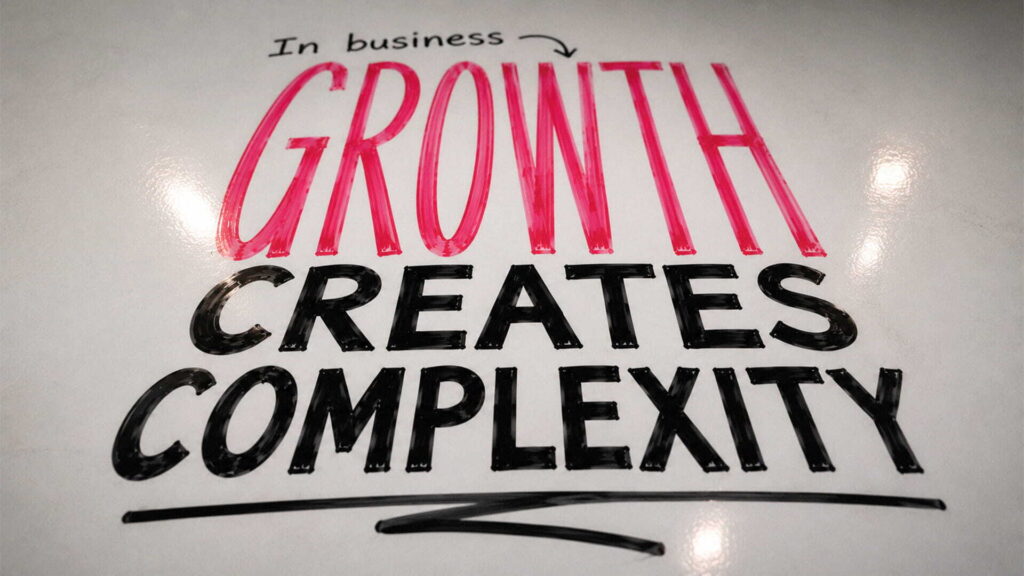
There’s a conversation we seem to have over and over again with growing businesses.
Different sectors. Different products. Different personalities. Different ambitions.
But underneath it all? Usually the same problem.
Not because the business has failed. Quite the opposite.
Most of the time, these businesses are successful.
They’ve grown quickly. They’ve gained traction. New services have emerged. Teams have expanded. Opportunities have opened up. The business has evolved far beyond what it originally was.
That’s the good news.
The bad news is that growth has a habit of exposing cracks.
And most businesses don’t realise those cracks exist until they start creating challenges everywhere else.
The frustrating part? They often can’t fully articulate the problem themselves.
They just know something feels off.
“Somewhere along the way, things stopped feeling connected.”
That’s usually how it starts. Not with a dramatic collapse. Not with some catastrophic event.
Just friction. Internal friction. External friction. Operational friction.
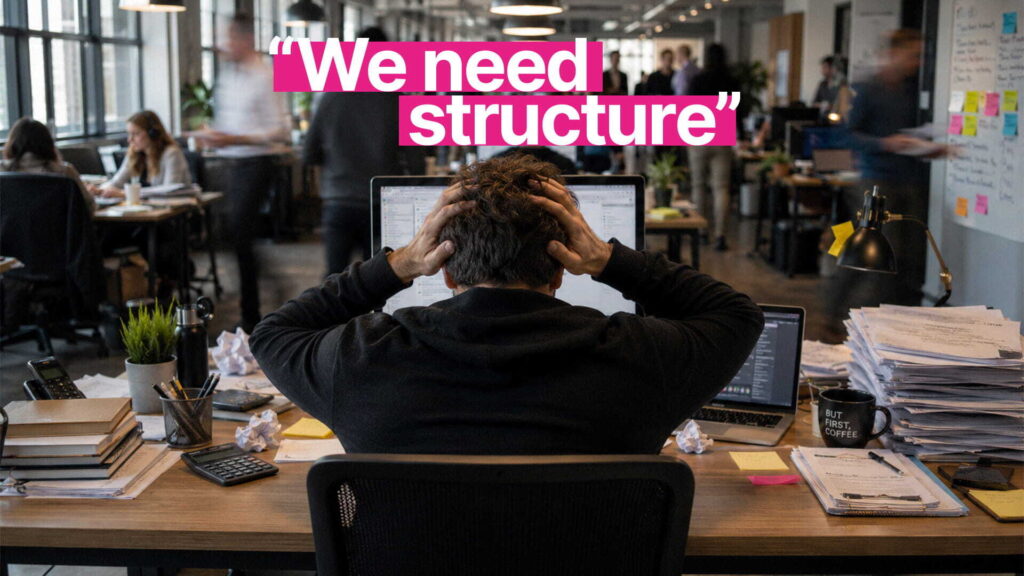
If you find yourself nodding along or saying “yes, yes, yes” to any of the following then, trust me, you’re not alone:
- The left hand stops talking to the right.
- The website no longer reflects the business.
- Sales and marketing feel disconnected.
- Teams begin creating their own versions of the brand.
- New services get bolted on without structure.
- Software gets added to solve short-term problems, but none of it properly talks together.
- Processes evolve reactively rather than strategically.
- Customers experience inconsistencies.
- Reporting becomes difficult.
- Nobody fully trusts the data.
- Leads come in, but conversion becomes unpredictable.
- Marketing activity increases, but clarity decreases.
And, eventually, the business reaches a point where the original foundations can no longer comfortably support the next phase of growth. That’s usually the real problem.
Not marketing. Not the website. Not the CRM. Not social media.
Those are symptoms.
The actual problem is normally that the business has outgrown the infrastructure, strategy and operational clarity it was originally built on.
Most businesses don’t build for scale in the beginning
And to be clear – that’s normal. In fact, it’s expected. When businesses first start growing, survival and momentum are the priority.
You solve problems in the moment.
You move quickly.
You say yes to opportunities.
You introduce new products.
You launch new services.
You hire people.
You adopt software.
You expand into new markets.
You evolve.
That’s what ambitious businesses are supposed to do.
Very few businesses sit down at the beginning and perfectly architect the systems, processes, brand structure, customer journeys, reporting mechanisms and digital infrastructure they’ll eventually need five / ten years later.
Because how could they?
You don’t know what the business is going to become yet. So most businesses grow organically first.
Then they reach a point where they need to stop, reassess and rebuild the foundations underneath the growth they’ve already achieved. That’s the stage many businesses find themselves in when they speak to us.
The problem usually isn’t what you think it is
A business will often approach us with a specific challenge.
- “We need marketing.”
- “Our website isn’t performing.”
- “Our CRM is a mess.”
- “We need more leads.”
- “Our messaging feels inconsistent.”
- “We’ve got too many disconnected systems.”
And while those things may all be true, the conversation almost always ends up somewhere deeper.
Because once we start digging, the same themes begin appearing.
- The business has evolved faster than its infrastructure.
- The positioning no longer reflects reality.
- The customer journey has become fragmented.
- The systems have become reactive.
- Internal teams are operating from different interpretations of the business.
- The brand has drifted.
- The customer experience lacks consistency.
- Nobody has stepped back and re-established the overall framework.
That’s why simply “doing more marketing” rarely fixes the issue long term.
If the underlying structure lacks clarity, all marketing tends to do is amplify the inconsistency faster.
Why good businesses become confusing
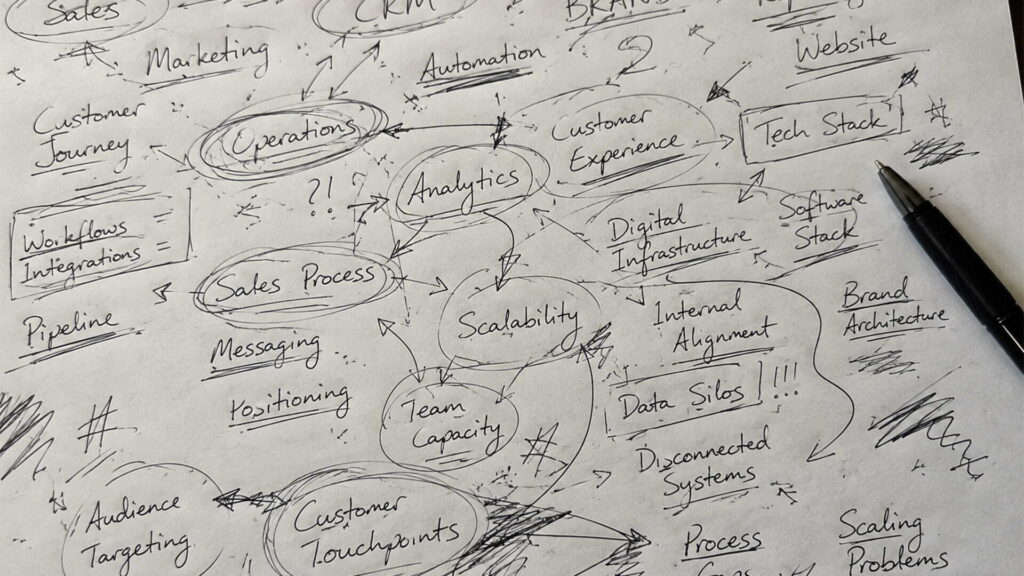
One of the biggest issues growing businesses face is complexity creep.
At the beginning, things are simple. The business has one service, one audience, one message and a clear identity.
Then growth happens. Suddenly there are:
- Multiple audiences
- Multiple services
- Multiple markets
- Multiple internal teams
- Multiple communication channels
- Multiple systems
- Multiple objectives
And over time, that complexity starts stacking on top of itself. A new service gets launched quickly. A sub-brand appears. A sales process changes. Different departments begin communicating differently. Technology gets introduced to patch gaps. The website evolves reactively. Messaging changes depending on who’s speaking.
Before long, the business starts feeling disconnected… both internally and externally.
Customers feel it. Teams feel it. Leadership definitely feels it.
But because the business has grown gradually into that position, it can be difficult to identify exactly where things started drifting.
That’s why outside perspective matters. Not because the business lacks intelligence. But because proximity makes objectivity difficult.
The businesses we work best with usually have one thing in common
They’re ambitious. That’s the common denominator. Sure, they’re normally led by people with vision. People who move fast. People who spot opportunities. People who’ve built something through hard work, instinct and momentum.
But, eventually even strong businesses reach points where instinct alone stops being enough.
That’s why the next stage of growth demands structure. Not restrictive corporate process for the sake of process.
Actual operational clarity.
Clear positioning.
Clear customer journeys.
Clear service architecture.
Clear reporting.
Clear systems.
Clear internal alignment.
Clear strategic direction.
Because scalable growth requires more than ambition. It requires infrastructure capable of supporting that ambition long term. Like a knife and fork, the two things go hand in hand.
Why we always start with strategy
One mistake businesses often make is jumping straight into outputs.
New website.
New campaigns.
New software.
New branding.
New ads.
New content.
But without understanding the underlying business objectives first, those outputs risk becoming disconnected very quickly.
That’s why strategy matters. And strategy, despite how agencies sometimes present it, isn’t a fluffy workshop exercise.
It’s practical.
It’s operational.
It’s commercial.
It’s understanding:
- What the business has become
- Where it wants to go next
- What’s currently getting in the way
- What customers actually experience
- Where friction exists
- Where opportunities exist
- What foundations need strengthening before scaling further
Only then can the right decisions be made around:
- Brand positioning
- Messaging
- Websites
- CRM systems
- Marketing channels
- Automation
- Customer journeys
- Reporting
- Sales enablement
- Operational processes
Without that clarity, businesses often end up investing heavily into disconnected tactics.
Technology alone doesn’t solve operational chaos
There’s no single silver bullet. This is especially true with digital infrastructure.
We regularly see businesses using multiple platforms and systems introduced at different times to solve different immediate problems.
A CRM here.
A spreadsheet there.
Different marketing tools.
Disconnected reporting.
Manual processes.
Patchwork automations.
And individually, none of those decisions were necessarily wrong.
They made sense at the time. The problem is what happens when years of reactive decision-making stack together without a unified strategic framework sitting above it all. That’s when businesses start spending more time managing systems than benefiting from them.
Technology should simplify operations. Not create more operational stress. The best systems are rarely the most complicated. They’re the ones that align properly with the business itself.
Marketing shouldn’t exist in isolation
Another common issue is treating marketing as a standalone function. In reality, effective marketing relies on the entire business ecosystem functioning correctly around it. Because marketing doesn’t stop at lead generation. It impacts:
- Customer perception
- Sales processes
- Onboarding
- Retention
- Reporting
- Customer experience
- Internal operations
- Long-term brand trust
You can generate all the leads in the world, but if the experience after conversion is fragmented, inefficient or inconsistent, growth becomes difficult to sustain. That’s why we care far more about what happens after the lead than vanity metrics at the top of the funnel.
Traffic is easy to inflate.
Lead numbers can be manipulated.
Real business growth is harder.
That comes from alignment.
The best type of growth is sustainable growth
There’s a big difference. A business can grow quickly while accumulating operational debt underneath the surface.
Eventually that debt catches up. Processes strain. Teams become reactive. Customers become confused. Leaders become overwhelmed.
Growth slows.
At that point, the solution usually isn’t simply “more activity.”
It’s clarity. Stepping back. Reassessing. Rebuilding where necessary. Strengthening the infrastructure beneath the ambition.
Now, let me underscore that this does not always mean a complete overhaul.
Sometimes small strategic changes create massive operational improvements.
Sometimes it means restructuring service architecture.
Sometimes it means repositioning the brand.
Sometimes it means rebuilding digital infrastructure.
Sometimes it means integrating systems properly for the first time.
Sometimes it means redefining customer journeys.
Sometimes it simply means creating alignment where fragmentation currently exists.
Every business is different.
But the pattern itself is remarkably common.
The value of strategic partnership
One thing we’ve learned over the years is that businesses get the best value from partners who are willing to look beyond the immediate brief.
Sometimes that means stepping back and asking bigger questions.
Sometimes it means challenging assumptions constructively.
Sometimes it means identifying operational or strategic issues sitting underneath the visible problem.
Because while businesses often come looking for marketing, websites or systems, the real challenge is usually broader than that.
Growth changes businesses.
Processes evolve.
Teams expand.
Services develop.
Technology stacks grow.
Communication becomes fragmented.
And over time, things that once worked perfectly well can start becoming harder to manage at scale.
That’s where outside perspective becomes valuable.
Not because businesses lack capability or vision, but because when you’re inside something every day, it’s naturally harder to spot disconnects, inefficiencies or inconsistencies forming over time.
The strongest long-term partnerships are usually built on that shared understanding.
Final thought
If any of this sounds familiar, you’re not alone.
In fact, it’s probably a sign your business has already achieved something meaningful.
Growth creates complexity.
That’s normal.
The important thing is recognising when the foundations need catching up with the ambition.
Because the businesses that scale successfully long term are rarely the ones moving fastest in every direction.
They’re the ones willing to pause, reassess and build properly for what comes next.